Antimicrobial activity of allicin on S. epidermidis.
Thirty seven strains of S. epidermidis from the hospital Infanta Cristina of Badajoz have been studied. These strains were characterized by the Micro Scan Pos Combo (Baxter Diagnostics) and the API system (Bio Merieux). Previously, all the strains were tested to resistence to methicillin using a 1 mg oxacillin disc with the Micro Scan Pos Combo system.
The allicin activity was determined by standard microdilutions in plate, and the results appear in Table 1. In general we found no significative differences in allicin’s activity irrespective to methicillin resistant or methicillin susceptible strains. The MIC 90 found was 8µg/mL, and the MIC 50 was 4µg/mL; range 0.125-16µg/mL. For the strains ATCC12228 & ATCC 35984 the allicin’s MIC was 8µg/mL.
Tabla 1.- Antimicrobial activity of allicin on 37 S. epidermidis. strains
|
|
MIC (µg/mL)
|
|
|
|
|
MIC50
|
MIC90
|
interval
|
|
Methicillin resistent (n =18)
|
4
|
8
|
<0.25-16
|
|
Methicillin sensitive
(n =19)
|
4
|
8
|
<0.25-16
|
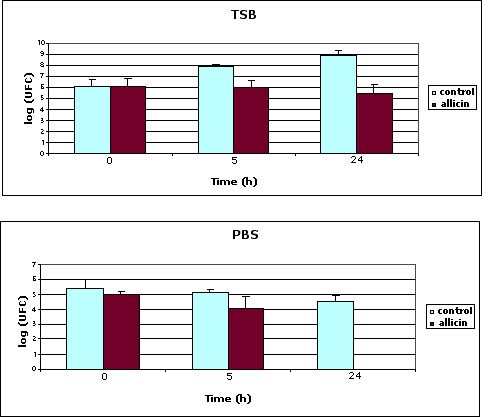
Figure 8. Activity of allicin at 80µg/mL (10xMIC) on S. epidermidis ATCC 35984 at the growing stage on TSB (graph above) and on a sterile medium of buffer phosphate (below)
In Figure 8 is depicted the activity of allicin on S. epidermidis ATCC 35984 in the exponential phase of growth. In the cultures without allicin the bacteria grow normally. When allicin at 80µg/mL (10xMIC) is added the bacterial culture doesn’t grow, and at 24 h the bacterial population lower to almost a magnitude order, but even so, there still remain about 2.75 105 UFC/mL. This bacteriostatic effect has already been described by another authors (27) on different bacteria. In addition, we studied the effect of allicin on a “non growing medium” (see Figure 8 below). Bacteria from a satationary phase were washed with PBS to eliminate the nutrition culture traces and they were resuspended in the same PBS. Then allicin at 80µg/mL was added and bacterial account was made at different times. The results ilustrated in Figure 8 b indicate that allicin produced an important diminution of the bacterial population at 5h (a decrease of 91.5% irrespective to control). No viable bacteria were detected after 24h of incubation.
As it was mentioned in the introduction, the generally accepted explanation of the antimicrobial action of allicin is the inhibition of sulphydryl active group of certain enzymes. In the literature consulted there are not specific studies on the inhibition mechanism of staphylococcus by allicin. However, a classical study on the synthesis of the bacterial membrane of S. epidermidis made in the 70’s by Wickus and Strominger (73) may provide some clues. These researchers studied the enzyme enolpiruvate-UDP-N-acetyl glucosamine transferase. This enzyme incorporates an enolpiruvate to UDP-N-acetyl glucosamine (UDP NAG) according to:
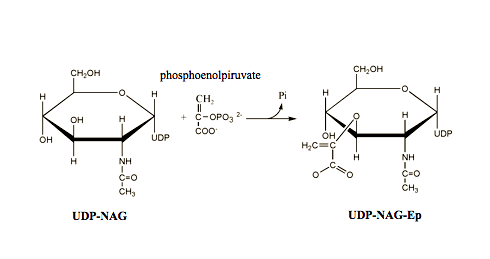
The resulting molecule UDP-NAG-enolpiruvate is transformed to N-acetylmuramic acid, a component of the bacterial wall. The assays with the mentioned enzyme showed a total inhibition with N-ethylmaleimide, a sulphydryl inhibitor.
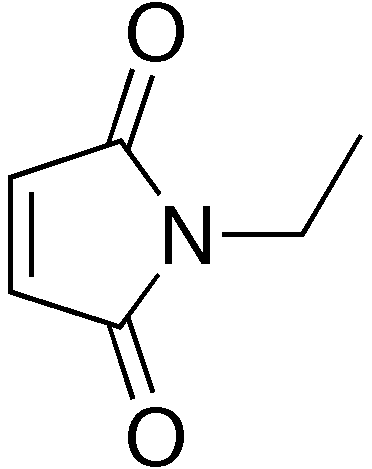
N-ethylmaleimide
The allicin molecules could pass through the cellular envelope and acting in a similar way to the referred compound.